If you’re ordering custom stickers for the first time, you’ve probably run into two terms that sound like they belong in a bakery, not a print shop: die cut and kiss cut. Every printer lists them, every quote asks you to pick one, and nobody explains what they actually mean.
Here’s the short version of the die cut vs. kiss cut stickers debate: it’s all about how the sticker is cut from the sheet — and that single choice affects how your stickers look, how they feel in the hand, how much they cost in bulk, and how easy they are to hand out.
This guide breaks it all down in plain English, so you can order with confidence the first time.
What Are Die Cut Stickers?
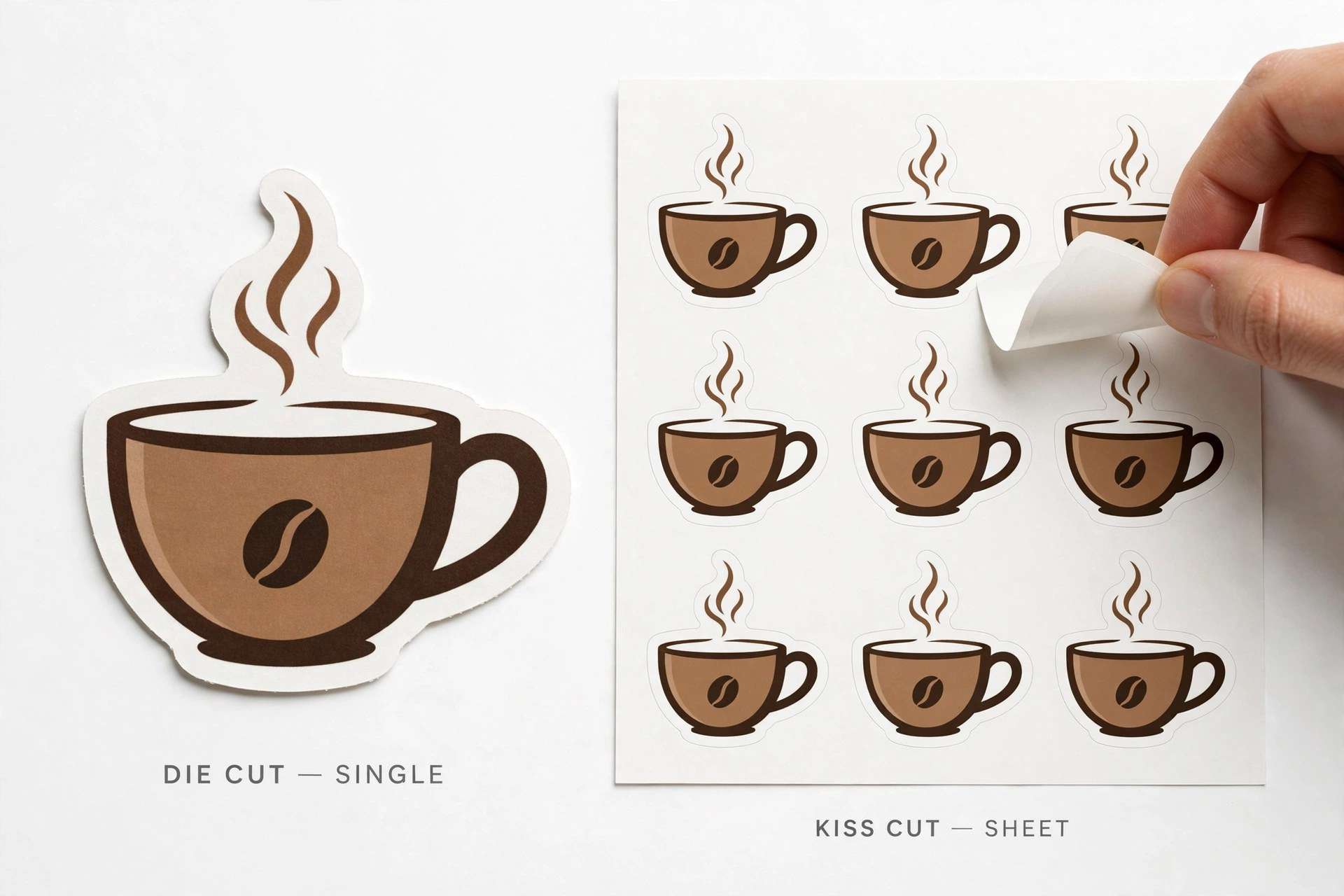
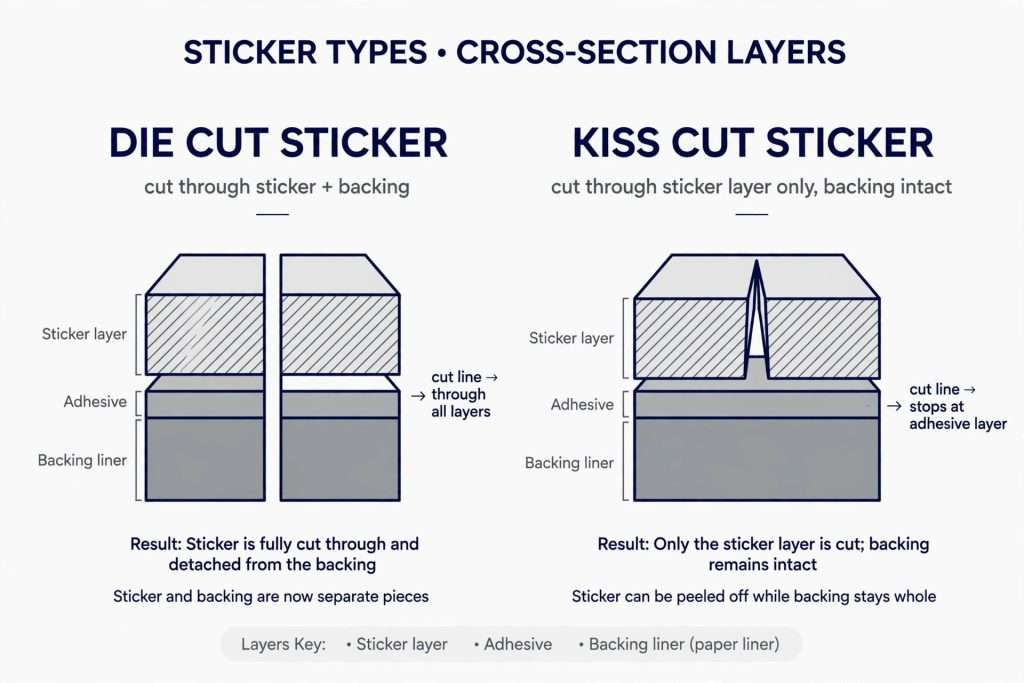
A die cut sticker is cut all the way through — through the sticker material and its backing paper — following the exact outline of your design. Think of it like a cookie cutter: if your logo is shaped like a coffee cup, the finished sticker is shaped exactly like a coffee cup, with no extra border around it.
Because each sticker is cut out individually, die cut stickers arrive as separate pieces (or on a roll, each one fully separated from its neighbors). You peel one off, and the shape you see is the shape you get.
Die cut stickers are known for:
- A clean, premium look — the sticker follows your artwork’s contour with nothing extra
- A satisfying “real product” feel that customers notice
- Easy one-at-a-time peeling, which makes them great for handing out at events or slipping into packaging
The trade-off? That precision cut takes more machine time, so die cut stickers usually cost a bit more per piece than kiss cut — especially in smaller quantities.
What Are Kiss Cut Stickers?
A kiss cut sticker is cut with a lighter touch. The blade “kisses” the surface: it slices through the sticker material but leaves the backing paper intact. The result is a sticker (or a whole set of stickers) sitting on a full sheet or roll of backing, like the sticker sheets you might remember from childhood.
Because the backing stays whole, kiss cut stickers are almost always delivered on sheets or rolls. You peel each sticker away from the backing when you’re ready to use it.
Kiss cut stickers are known for:
- Lower cost per sticker, especially in large runs — the cutting process is faster and simpler
- Easy storage and distribution — a sheet of stickers is tidy to stack, ship, and hand out
- A printable backing — many printers can print your branding, instructions, or a QR code on the backing paper itself, turning it into bonus marketing space
- Flexibility for multi-design sheets — you can put several different designs on a single sheet, which is perfect for variety packs or product lines
The trade-off is mostly visual: a kiss cut sticker on its backing looks a little less “finished” than a die cut piece, and peeling individual stickers from a sheet is slightly slower if you’re applying hundreds by hand.
Die Cut vs. Kiss Cut Stickers: Side-by-Side Comparison
Here’s how the two styles stack up on the factors that matter most to small businesses:
| Die Cut | Kiss Cut | |
|---|---|---|
| How it’s cut | Through sticker + backing, along your design’s outline | Through sticker layer only; backing stays whole |
| How it arrives | Individual pieces (or roll) | Sheets or rolls |
| Look & feel | Premium, contour-shaped, no excess border | Clean, but sits on a visible backing until peeled |
| Typical cost | Higher per piece (more machine time) | Lower per piece, especially in bulk |
| Bulk-friendly | Good — easy to peel one at a time | Excellent — sheets stack and ship efficiently |
| Handing out | Great for events, packaging inserts | Great for retail sheets, variety packs |
| Backing paper | Cut away with the sticker | Stays intact — can be printed with branding |
| Multiple designs per order | Usually priced per design | Easy to combine designs on one sheet |
The key takeaway: die cut wins on presentation and perceived quality; kiss cut wins on cost, versatility, and the bonus branding space on the backing. Neither is objectively better — it depends on what job the sticker has to do.
Which Should You Choose? Recommendations by Industry
Cafés, Restaurants & Food Brands
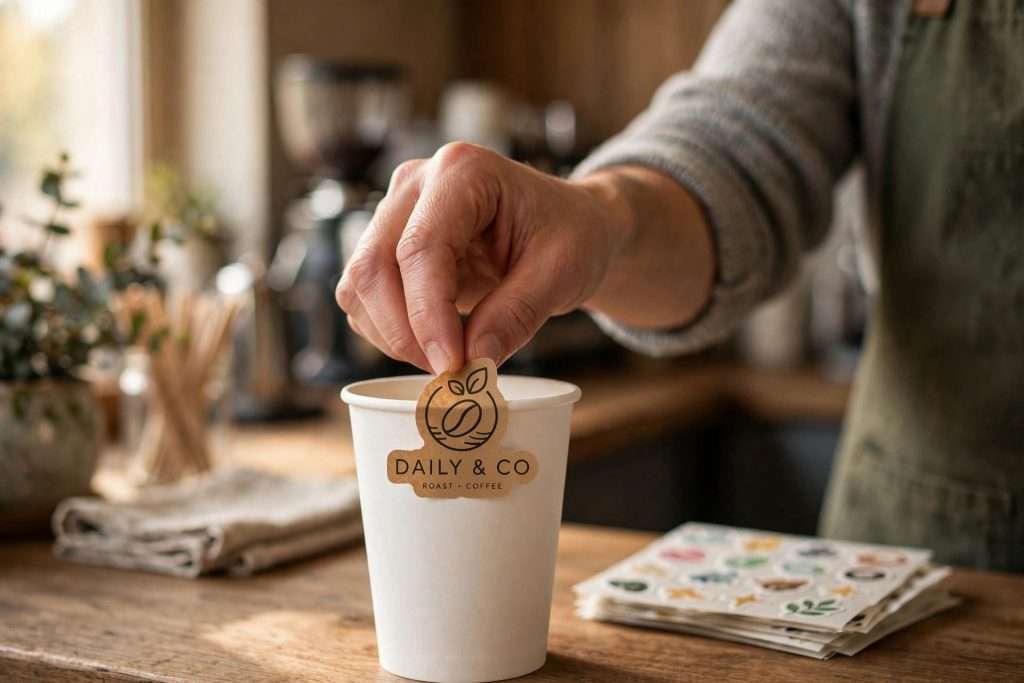
Go die cut for your logo stickers. A contour-cut logo on a coffee cup, takeout bag, or pastry box looks deliberate and high-end — it reads as branding, not an afterthought. If you’re sealing bags or boxes in volume, though, consider kiss cut on a roll: they’re faster to peel during a busy rush and cost less when you’re going through thousands.
Beauty, Candles & Handmade Products
This is kiss cut territory. Handmade brands usually need several designs — a logo, an ingredients label, a “thank you” seal — and a kiss cut sheet lets you combine them in one order. One practical note: the cut style doesn’t determine waterproofing. If your labels will meet oils, wax, or bathroom humidity, ask for a waterproof material like vinyl or BOPP. Either cut style can be made waterproof; it’s the material that matters.
Clothing & Apparel Brands
Die cut for the win. Apparel is a visual business, and a precisely cut logo sticker tucked into an order or stuck on a shopping bag reinforces the brand every time. Many clothing brands also use stickers as hang-tag companions or freebies — in both cases, the premium feel of die cut pays off.
Ecommerce & Packaging
For box seals, kiss cut on a roll is the workhorse choice. Rolls feed quickly, the per-sticker cost stays low at volume, and a branded backing isn’t needed when the sticker itself carries your logo. If your unboxing experience is part of your brand (and it should be), add a die cut sticker as a surprise insert — it’s a small cost that customers remember.
Frequently Asked Questions
What is the minimum order quantity for custom stickers?
It varies by printer and printing method. Many custom printers start digital runs at around 50 to 100 stickers, which is friendly for small businesses testing a design. Larger offset or flexo runs usually start higher but bring the per-piece price down significantly. If you’re not sure, ask for quotes at two or three quantities — the price break between 500 and 1,000 pieces is often bigger than people expect.
Are die cut and kiss cut stickers waterproof?
The cut style doesn’t decide this — the material does. Stickers printed on vinyl or BOPP with waterproof inks handle rain, refrigeration, and oily fingers just fine, whether they’re die cut or kiss cut. Paper stickers, on the other hand, will not survive water exposure. Always confirm the material with your printer if your stickers will face moisture.
What file format should my artwork be in?
Vector files (AI, EPS, or PDF) are ideal because they scale to any size without losing sharpness. A high-resolution PNG (at least 300 DPI at the final print size) also works for most digital runs. Set your colors to CMYK rather than RGB, and include a small bleed area — usually about 3mm or 1/8 inch — around the edge of your design so the cut doesn’t leave white slivers. If any of that sounds unfamiliar, most printers will check your file and flag problems before printing.
Can I get a proof or sample before full production?
Most printers provide a free digital proof — a PDF showing your design at size with cut lines marked — before anything goes to press. Always approve it carefully; it’s your last chance to catch typos and sizing issues. Physical samples are also common, though they may add a few days and a small fee. For a first order, a physical sample is worth it.
How long do production and delivery take?
Timelines vary, but a typical digital sticker order runs about 5 to 10 business days for production after you approve the proof, plus shipping time. Larger or specialty orders (foil, embossing, unusual materials) take longer. If you need stickers for a specific event or launch, order at least three to four weeks ahead — rush production is sometimes available but costs more.
Can I mix multiple designs in one order?
Yes — and this is where kiss cut shines. Multiple designs can share a single kiss cut sheet, so you pay for one setup instead of several. With die cut, each unique shape generally needs its own cutting die or setup, so mixing designs usually means ordering them as separate line items. If you need variety on a budget, ask your printer about a multi-design kiss cut sheet.
The Bottom Line
The die cut vs. kiss cut stickers decision comes down to a simple question: is this sticker meant to impress, or meant to work hard in volume?
- Choose die cut when presentation matters most: logo stickers, brand freebies, premium packaging inserts.
- Choose kiss cut when cost and versatility matter most: multi-design sheets, box seals, high-volume handouts — plus the bonus of a printable backing.
Still not sure? You don’t have to guess. Browse ZORVOO’s custom sticker options, send us your artwork, and we’ll help you pick the right cut, material, and quantity for your budget — with a free digital proof before anything goes to print.